@RoguePOTUSStaff Is Probably a Fraud
A lot of “alternative” and “rogue” Twitter accounts have popped up in the past two weeks claiming to represent disgruntled federal employees taking a stand against the Trump administration. Most of these have already devolved into not much more than a retweet machine for the #resist hashtag. One of them, though, is particularly interesting: @RoguePOTUSStaff claims to be a group of insiders at the White House opposing the administration and has been “leaking” some very juicy tidbits over the past 12 days. If this account is authentic, what a journalistic coup that would be! But I don’t think that’s what’s happening.
In this post I’m going to lay out why I believe @RoguePOTUSStaff (hereafter referred to as “RPS”) is a fraud.
Many have already decided RPS is a credible source, which is quite a shame, because there is in fact no evidence to support their credibility. Bill Palmer has probably been the most prolific on this front, writing six articles reporting RPS allegations as news. Let’s take a look at what Palmer believes proves RPS is real:
Here’s what we do know: the @RoguePOTUSStaff has made three assertions thus far which were ultimately proven true. The first was that the President of Mexico had canceled his meeting with Donald Trump, and that Trump had decided he was going to post a tweet saying he didn’t want the meeting anyway. The second was that Mike Pence would be included on Trump’s phone call with Vladimir Putin. The third was that Neil Gorsuch had been picked for the Supreme Court. None of these are high level details. But none of them were publicly known at the time they were tweeted, and they were all later proven to be accurate.
It is correct that RPS made these three assertions, and also correct that they all turned out to be accurate. But it is not true that “none of them were publicly known at the time they were tweeted.” In fact, the latter two had been previously reported elsewhere, and the Nieto cancellation was easy to guess. As we’ll see with these and many other examples, I believe RPS’s MO is to follow up on others’ reporting with their own assertions, adding an unverifiable speculative twist. In every single case where RPS has made an accurate “prediction,” members of the media had already reported those pieces of information. What’s more, RPS made several predictions that never came true, or put out confused information that did not comport with the facts. In one case RPS even directly plagiarized another user.
So let’s take each assertion in turn and unpack the order of events.
On Peña Nieto canceling his U.S. visit
Here’s the first we heard from RPS on this one:
Word is Mexican Pres. cancelling upcoming meeting. POTUS plans twitter announcement to make it sound like his idea.
— Rogue POTUS Staff (@RoguePOTUSStaff) January 26, 2017
And here’s the corresponding Trump tweet:
of jobs and companies lost. If Mexico is unwilling to pay for the badly needed wall, then it would be better to cancel the upcoming meeting.
— Donald J. Trump (@realDonaldTrump) January 26, 2017
Note that the Trump tweet is posted a full 17 minutes before the RPS tweet. You could claim RPS predicted Peña Nieto canceling, but considering Trump encouraged him to do so, that wasn’t much of a stretch. Later in the day, RPS then claims Trump has ordered Spicer to say the meeting will be rescheduled:
POTUS has ordered Spicer to say meeting will be rescheduled even though POTUS has no interest in doing so.
— Rogue POTUS Staff (@RoguePOTUSStaff) January 26, 2017
In fact, Spicer had already told the press the meeting would be rescheduled, and that was known over three hours earlier:
Spicer on scrapped EPN Trump visit:"We'll look for a date to schedule something in the future. We will keep the lines of communication open"
— Jim Acosta (@Acosta) January 26, 2017
Pence & Putin
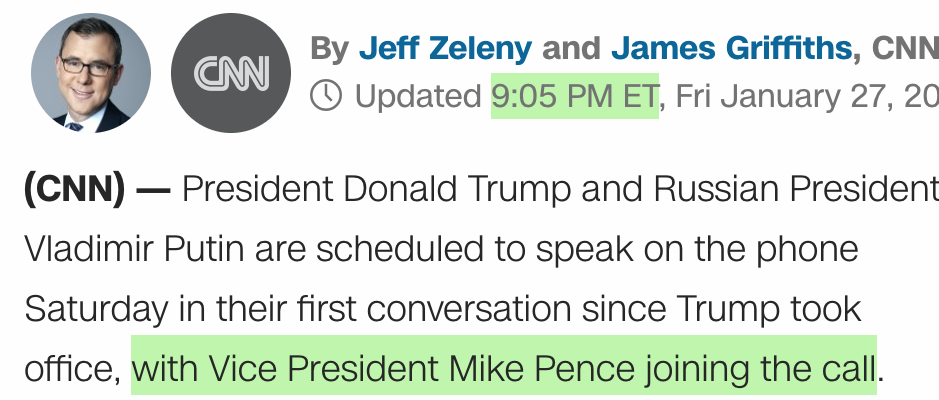
Regarding Palmer’s second “proven” assertion, here’s RPS’s tweet:
VP Pence to sit in on POTUS/Putin phone call tomorrow. POTUS doesn't like idea, but gave in to pressure from #UnholyTrinity .
— Rogue POTUS Staff (@RoguePOTUSStaff) January 28, 2017
But this fact had already been reported by CNN almost an hour earlier:
The Gorsuch nomination
The formal Gorsuch announcement occurred the night of Jan 31. Here’s the day before:
I have made my decision on who I will nominate for The United States Supreme Court. It will be announced live on Tuesday at 8:00 P.M. (W.H.)
— Donald J. Trump (@realDonaldTrump) January 30, 2017
#UnholyTrinity back Gorsuch for SCOTUS. Had POTUS convinced. But POTUS swaying back to Hardiman for spite, despite look of more nepotism.
— Rogue POTUS Staff (@RoguePOTUSStaff) January 30, 2017
And here’s the day of the announcement:
Two @scotus finalists - Gorsuch and Hardiman - being brought to Washington ahead of announcement, @CNN learns. Many signs point to Gorsuch.
— Jeff Zeleny (@jeffzeleny) January 31, 2017
POTUS getting eye rolls at flip-floppity attitude toward SCOTUS pick. After settling from crazy weekend, seems back on the Gorsuch train.
— Rogue POTUS Staff (@RoguePOTUSStaff) January 31, 2017
SCOOP: Here is Trump's SCOTUS pick:https://t.co/lakw5LrAqa
— Benny (@bennyjohnson) January 31, 2017
Gorsuch is POTUS final answer. Paperwork is being drawn up. #UnholyTrinity reinvigorated by POTUS cooperative attitude. For now...
— Rogue POTUS Staff (@RoguePOTUSStaff) January 31, 2017
Repeat: Neil Gorsuch to be nominated to Supreme Court of the United States by President Trump.
— Rogue POTUS Staff (@RoguePOTUSStaff) January 31, 2017
White House Press Secretary Sean Spicer claimed Trump informed Gorsuch of his decision on Monday and Gorsuch came to DC Monday night. The New York Times reported that “the day began with a phone call from Don McGahn, the White House counsel, who informed Judge Hardiman that Mr. Trump’s pick would be Judge Neil M. Gorsuch.”
So here’s the timeline (Eastern time):
- Jan 30, 8:43am: Trump claims he has made his decision
- Jan 30, evening: Gorsuch flown to DC
- Jan 31, morning: Hardiman informed he’s not the pick
- Jan 31, 2:30pm: RPS asserts Trump still deliberating his SCOTUS pick but leaning toward Gorsuch
- Jan 31, 2:39pm: Benny Johnson reports Gorsuch is “100%” guaranteed
- Jan 31, 2:43pm: RPS asserts Gorsuch is Trump’s “final answer”
- Jan 31, 8:00pm: Trump announces it’s Gorsuch
So if Trump made his decision on Monday and Gorsuch flew to DC that same night, why is RPS asserting Trump is still deliberating Tuesday afternoon? Even if Trump and Spicer are both lying, for RPS to be believed Trump would have to have made his decision a mere six hours before the announcement.
Furthermore, RPS also claimed that Priebus was “worried about public anger if they learn POTUS wasted tax $$ to bring in SCOTUS loser for Apprentice style nom. announcement”, following media reports sourced to White House officials that Hardiman was coming to DC for the final showdown with Gorsuch before Trump. But we later learned Hardiman never came to DC. And if you don’t believe Spicer, the Times article puts Hardiman visiting a fellow judge in Altoona on the 31st. So it appears RPS is doing nothing more than latching onto media reports. Why would Priebus be worried something that never happened might be disclosed?
The last thing I’ll mention regarding the Gorsuch episode is this tweet:
Priebus points out to POTUS that having sons in front row undermines appearance that POTUS is separated from business activities.
— Rogue POTUS Staff (@RoguePOTUSStaff) February 1, 2017
Again, RPS has piggybacked directly onto someone else’s observation:
With Trump sons sitting front row for #SCOTUS announcement, are other CEOs of American companies present? More #Conflict.
— Alt Dept of State (@AltStateDpt) February 1, 2017
That covers it for the three assertions Palmer believes prove RPS’s credibility, and hopefully I’ve shown they do nothing of the sort. But there is plenty more evidence of RPS doing nothing more than jumping on the media bandwaggon.
The LGBT Executive Order that wasn’t
RPS piggybacked directly onto media discussion of a supposed anti-LGBT Executive Order after rumors started swirling and RPS were directly asked if they had any information. They claimed the rumors were true and the order should be expected by the “end of the week”, while asserting there was a “small chance” it would be abandoned, though that was “unlikely”. The next we heard from them on the matter was that same night when they posted a Times article reporting the order had been shelved, adding “after the enormous pressure from the past several days, POTUS repudiates VP, reverses course on LGBT EO”. Again, this was the same night, less than 7 hours since their previous assertion that it was “unlikely” to be scrapped. RPS, which claimed to be plugged into the issue, did not preempt media coverage that the order had been killed.
@RoguePOTUSStaff there are rumors of anti LGBT EO coming. Can you shed light on that?
— I am America (@devchelle) January 30, 2017
Rumors are true. Expect by end of the week. https://t.co/Mx89ZaY4ND
— Rogue POTUS Staff (@RoguePOTUSStaff) January 30, 2017
I'm told reliably there is a draft Executive order on LGBT issues including adoption. Details and timing unclear.
— Josh Rogin (@joshrogin) January 30, 2017
Confirmed, @joshrogin . Nuances are being hammered out. Still small chance it may be abandoned, to avoid more bad press. But unlikely. https://t.co/fpnus5u9Mq
— Rogue POTUS Staff (@RoguePOTUSStaff) January 30, 2017
After the enormous pressure from the past several days, POTUS repudiates VP, reverses course on LGBT EO. #resistwin https://t.co/F5T1QrIiEh
— Rogue POTUS Staff (@RoguePOTUSStaff) January 31, 2017
The State Department resignations
When the media narrative was that there had been high-level resignations at the State Department, RPS claimed Trump was irate, and that he was planning on moving to a “torture-first” foreign policy:
Under Secy Kennedy is a traitor for resigning, according to POTUS. Kennedy departs over POTUS plans for a "torture first" foreign policy.
— Rogue POTUS Staff (@RoguePOTUSStaff) January 26, 2017
POTUS undeterred on hiring freeze in light of exodus of govt employees. Says Depts must "get the job done it you're fired." #celebrityPOTUS
— Rogue POTUS Staff (@RoguePOTUSStaff) January 26, 2017
As soon as the narrative shifted, so too did RPS:
@Caitlin805 Asked to resign, given ultimatum, tomato, tomato. Kennedy refused to buy in, so now POTUS says he's a traitor.
— Rogue POTUS Staff (@RoguePOTUSStaff) January 26, 2017
White House dress code
Axios reported Trump’s exacting standards for how he expects those who work for him to look:
Trump judges men’s appearances as much as women’s. A source who’s worked with Trump explains: “If you’re going to be a public person for him, whether it’s a lawyer or representing him in meetings, then you need to have a certain look. That look —at least for any male — you have to be sharply dressed. Preferably, I would say, solid colors. … You should have a good physical demeanor, good stature, hair well groomed.”
Trump pays close attention to ties. Says a source who has worked with Trump: “You’re always supposed to wear a tie. If it’s not a Trump tie, you can get away with Brooks Brothers. But I’d suggest Armani.” Trump prefers wider, traditional ties, this source says. Regarding Trump’s rakish policy adviser Stephen Miller, the source adds: “I’ve always been surprised about how Stephen Miller survives with those thin ties.”
Trump likes the women who work for him “to dress like women,” says a source who worked on Trump’s campaign. “Even if you’re in jeans, you need to look neat and orderly.” We hear that women who worked in Trump’s campaign field offices — folks who spend more time knocking on doors than attending glitzy events — felt pressure to wear dresses to impress Trump.
RPS retweeted this report itself and said it “took the words right out of our mouths”, proceeding to “confirm” its allegations.
Trump 101: The producer of his own epic film https://t.co/E1vkGOVGyq pic.twitter.com/Ja12IxQ32N
— Axios (@axios) February 2, 2017
Took the words right out of our mouths.
— Rogue POTUS Staff (@RoguePOTUSStaff) February 2, 2017
Trump 101: The producer of his own epic film https://t.co/LUCx16HsZE via @YouTube
We can confirm that POTUS is encouraging people to buy his brands in order to have the "right look" to work for his administration.
— Rogue POTUS Staff (@RoguePOTUSStaff) February 3, 2017
@pattydineen Statements like "You look like s--- w/ that tie. Here, look at ties I sell. This is the kind of look you need to work for me."
— Rogue POTUS Staff (@RoguePOTUSStaff) February 3, 2017
RPS has again done nothing more than taken a media report and put a spin on it.
Iran & Russia
RPS chimes in on imminent Iran sanctions after media starts reporting on it:
The Trump administration reportedly is poised to impose new sanctions on Iran. https://t.co/ANt6ftl2Rz pic.twitter.com/V3pOJyHgCb
— Marcy Kreiter (@marcykreiter) February 2, 2017
With Priebus mostly boxed out, planning chatter for Iran sanctions taking reckless tone, with panic giving way to desperation, hopelessness.
— Rogue POTUS Staff (@RoguePOTUSStaff) February 2, 2017
On Russia, RPS retweeted George Takei’s contention that Trump was “easing sanctions on the very cyber groups responsible for the hacks”. Of course, if they’d only waited until the initial hysteria died down, they would have seen that the move did no such thing.
RPS is also adamant that Trump’s inner circle believes he has been compromised by Putin:
#UnholyTrinity urging POTUS that if Putin is compromising him to allow them to help. POTUS continues to deny, despite firm intelligence.
— Rogue POTUS Staff (@RoguePOTUSStaff) January 28, 2017
Seen as first tacit admission by POTUS of some level of complicity between him and Putin regarding Russian interference in election.
— Rogue POTUS Staff (@RoguePOTUSStaff) February 2, 2017
Of course, no such “firm intelligence” is publicly available.
Quebec mosque attack
I think the most egregious of RPS’s allegations is this one:
POTUS asks why he should "give a damn about muzzie Canucks?"
— Rogue POTUS Staff (@RoguePOTUSStaff) January 30, 2017
Leaving aside the obvious cruelty of such a remark, this language is very odd. I won’t presume to speak for the entire country, but I have never heard American friends refer to Canadians as “Canucks”, and I don’t think most Americans—except those who grew up near the Canadian border—are even familiar with that usage of the word, let alone would use it in everyday conversation. “Canucks” is much more popular among Canadians themselves. And until I read this tweet, I had never even heard the word “muzzie” to mean “Muslim”.
Here’s what the Google Trends data have to say about “muzzie” and “muzzie Canucks”:
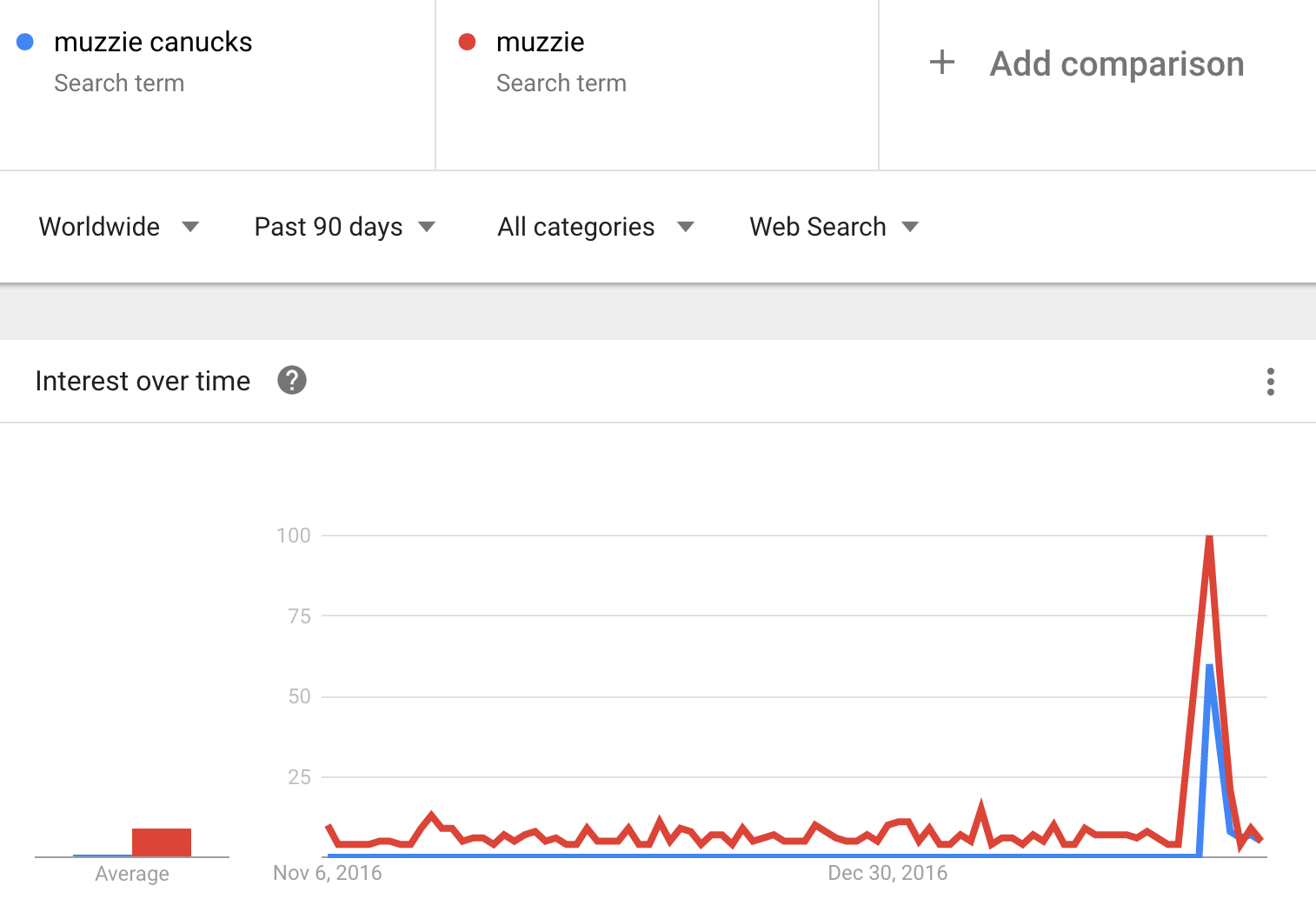
That huge spike there? Yep, that’s around 1pm on January 30—the same time as the RPS tweet. Up until then, “muzzie Canuck” itself was an absolute flatline—literally not searched for; and “muzzie” was a very low-volume search. Indeed, in my searching around for it, it mostly comes up in the comments section of Breitbart and similar outfits, obviously as a derogatory term. I also couldn’t find any public instance in which Trump uses either the word “muzzie” or “Canuck”, though if you know of one please let me know.
Voter fraud
RPS stepped into the discussion on the multiple voter registrations of Trump’s family and inner circle well after those reports broke:
We've confirmed what @heatstreet reported, that @realDonaldTrump's daughter Tiffany is also registered to vote in 2 states, Pa and NY. https://t.co/REL4Y4lhr1
— David Fahrenthold (@Fahrenthold) January 25, 2017
Tensions raw around the West Wing. Possibility that POTUS family members may have actually voted twice at his urging.
— Rogue POTUS Staff (@RoguePOTUSStaff) January 27, 2017
Update on #votegate, while POTUS ordering dbl votes unlikely, may have tried directing which state to vote in.
— Rogue POTUS Staff (@RoguePOTUSStaff) January 27, 2017
Of course, many people who have moved accross state lines are registered to vote in two states. What’s revealing about this RPS allegation is that it adopts the exact same voter fraud motivation liberals are resisting, namely, that erroneous voter registrations are evidence of fraud, instead of evidence of America’s byzantine electoral system.
Muslim registry or ban?
On the 26th, the day Huffington Post reported on the draft of Trump’s immigration EO, RPS initially began alleging Trump would be establishing a Muslim “registry”, a campaign promise he later walked back. Bizarrely, they claim that “if everyone joins it also becomes useless”, as if the Muslim registry would be a sort of Facebook-like system that anyone could “join”, to “stand in solidarity” with Muslims.
A Muslim registry would be unconstitutional. If everyone joins it also becomes useless. Stand in solidary. #resist
— Rogue POTUS Staff (@RoguePOTUSStaff) January 26, 2017
They then claimed Trump was excited about DHS’s “new expedited screening” program and it would be used in conjunction with the Muslim registry:
POTUS said to be excited about new DHS #expeditedscreening program. to be used in conjunction with #Muslimregistry .
— Rogue POTUS Staff (@RoguePOTUSStaff) January 26, 2017
To put that in context, see this DHS tweet from just an hour earlier:
#Expeditedscreening programs such as #PreCheck enable trusted travelers to enjoy secure and efficient screening pic.twitter.com/rTsOJBfNFE
— Homeland Security (@DHSgov) January 26, 2017
Of course, PreCheck has been around for years, making it anything but “new”. The only news on that front on the 26th was a TSA announcement that 11 additional airlines had been added to the program.
And then RPS pivots seamlessly to the Muslim ban, forgetting all about the Muslim registry that never materialized:
#MuslimBan said to be necessary because of 9-11, but none of the home countries of 9-11 hijackers are included in ban. pic.twitter.com/hG3q99hh90
— Rogue POTUS Staff (@RoguePOTUSStaff) January 28, 2017
This observation was 100% plagiarized, image and all, from NBC’s Bradd Jaffy:
Trump order begins by invoking 9/11 three times
— Bradd Jaffy (@BraddJaffy) January 28, 2017
9/11 hijackers were from Egypt, Saudi Arabia, UAE & Lebanon
None of those countries banned pic.twitter.com/WaRyiBZ1S0
But wait! A “contact at DOJ” told RPS the POTUS order to suspend green cards may have “created new illegals out of those already here”:
Contact at DOJ suggests side effect of POTUS order to susp visas, green cards may be that it created new illegals out of those already here.
— Rogue POTUS Staff (@RoguePOTUSStaff) January 28, 2017
I’m not sure what this is supposed to mean—that ICE will begin rounding up green card holders? Or just that they won’t be allowed back into the US if they travel abroad? It’s not coherent. But has RPS just broken the news that green card holders were being affected?
Nope. It had already been well established by this point that the order was causing green card holders to be detained/deported:
Trump’s order has already blocked green card and visa holders at airports from traveling to the United States https://t.co/JI0DoW32AC
— Liam Stack (@liamstack) January 28, 2017
Please report anyone with a green card denied entry to the U.S. https://t.co/7McjSoI03u
— Mana Yegani (@Law_Mana) January 28, 2017
Green card holders should NOT give in to pressure to give up their green cards on entry. Negotiate
— Mana Yegani (@Law_Mana) January 28, 2017
Don't sign Form I-407.#MuslimBan
RPS also claims POTUS ordered Spicer to accuse people protesting his ban with “compromising national security”:
Under early morning advice from Bannon POTUS to push Spicer to accuse #MuslimBan protests of compromising national security.
— Rogue POTUS Staff (@RoguePOTUSStaff) January 30, 2017
I haven’t been able to find any evidence of Spicer making such a claim. In the press briefing that day, Spicer ignores a question on the protesters:
: On the message to the protesters and specifically to the families who this weekend were caught up in this?
: Yeah. And I – I think that it’s a shame that people were inconvenienced obviously, but at the end day, we’re talking about a couple hours. I would rather – you know, I’m sorry that some folks may have had to wait a little while, but I think the president would much rather know that he’s not placing a call to someone who was killed because someone was let into this country to commit a terrorist act.
RPS also picks up on Jake Tapper’s report that the administration is considering asking visitors to the US “to disclose all websites and social media sites they visit”:
The White House is discussing asking foreign visitors for social media info and cell phone contacts https://t.co/18wNDcJjvL pic.twitter.com/WSbemH8y5l
— CNN (@CNN) January 29, 2017
#UnholyTrinity frustrated with POTUS idea to screen visitors for websites they frequent, notiing that malicious actors would just lie.
— Rogue POTUS Staff (@RoguePOTUSStaff) January 29, 2017
Pentagon review of F35 program
RPS alleged Trump was telling Boeing he would drop Lockheed Martin’s F35 jet in favor of an “old Boeing model” in exchange for a lower Air Force One cost. This comes a day after Secretary of Defense James Mattis ordered a review of both Air Force One and the F35 program, including to assess “the extent that F/A-18E/F improvements (an advanced Super Hornet) can be made in order to provide a competitive, cost effective, figher aircraft alternative.” That “advanced Super Hornet” would be none other than a Boeing model.
HERE WE GO: SecDef Mattis orders official reviews of AF1 and F35- including comparison to F18. pic.twitter.com/UCi1sSDOqB
— Aaron Mehta (@AaronMehta) January 27, 2017
POTUS renegotiating 101: Plans to convince Boeing to "lower" cost of new AF1 by dropping new LM stealth jet in favor of old Boeing model.
— Rogue POTUS Staff (@RoguePOTUSStaff) January 28, 2017
The EU data sharing pact
They brought up Trump’s changes to privacy regulations only after others had:
EU silent as US government suspends legal framework enabling the US-EU data-sharing pact (#PrivacyShield).
— Edward Snowden (@Snowden) January 26, 2017
1: https://t.co/JkbJhTrUsI
2: https://t.co/k7IazTtnwG
Real concern starting to emerge that POTUS not even acting as he believes best, just for spite. Ex: gutting EU data law because Obama.
— Rogue POTUS Staff (@RoguePOTUSStaff) January 26, 2017
The biggest allegations
So we’ve seen that while RPS has sometimes made accurate “predictions”, these always came after the first public reports. And we’ve seen other times they’ve made predictions that never came true at all. But there’s also a class of RPS tweets that comprise incredibly explosive allegations, none of which (to my knowledge) has been confirmed by any reputable source:
- Jared Kushner’s role is “to advise POTUS how govt can aid Trump Organization’s profit margins”
- Trump “asked around” for someone to Photoshop his inauguration photos
- Trump supports California’s secession from the US and wants the GOP to give them money
- Trump wanted to shut down the IRS audit of his taxes
- A full-on insurgency is forming in the White House
- Mike Pence, Reince Priebus, and Paul Ryan are scheming to impeach Trump
Conclusion
RPS has said many times that they will not prove their authenticity to anyone, even a journalist:
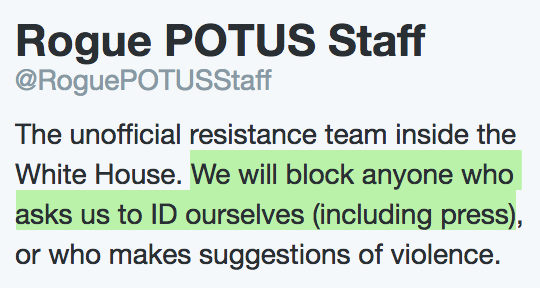
They also claim their activities might violate the Hatch Act and they could be prosecuted for “espionage”. I’m not a lawyer, so I won’t speak to whether RPS’s tweets are a violation of the Hatch Act. But it appears “removal is the only penalty authorized for violation” even if they are. In any case, it’s certainly not an espionage statute, and I don’t understand how RPS could possibly be prosecuted for espionage. I’ll also go ahead and note that the Hatch Act had recently been in the news following the controversy over a Secret Service agent’s social media post about Trump.
RPS exhibits a pattern of taking credible reporting from other sources and adding an insider patina that seems juicy. In every case where they’ve made an accurate prediction, someone else preempted them. In many cases they made inaccurate predictions, confused facts, and stole others’ observations. Whoever is behind the account is obviously a close observer of the media.
All of this leads me to my final point: why does any of this matter?
Emptywheel today wrote about the “fake news” phenomeon as applied to the left, taking issue with, among other things, BuzzFeed’s inclusion of RPS in a list of fake news stories. Marcy says: “Most of these things are not news! Most are not pretending to be news!” I suppose it’s strictly true that RPS does not pretend to be news, but it also isn’t obvious parody and all you have to do is look at the replies to its tweets to see that scores of people take it very, very seriously. I share her concern that the “fake news” label “provides a way to discredit alternative voices”, but I don’t believe there is a clear distinction between Twitter and news anymore. I don’t care whether RPS portrays itself as “news” or not—the reality is that people believe it is authentic, and that is dangerous when they refuse to prove they are who they say they are.
On Jan 29, I reached out directly to RPS to suggest a way to prove their credibility without having to reveal their identity to anyone: post some encrypted messages detailing actions POTUS will be taking in the coming days (so their actual contents would be obscured), and then post the decryption key after the action has been publicly announced. A series of these amounting to more than sheer speculation that turn out to be correct would prove RPS had foreknowledge of the action without having to identify themselves, preempt the administration’s public announcement, or tell any human being who they are. I never received a response, but I still think this is a workable solution, and invite RPS to prove their credibility. Until then, they—and all these other accounts—should be regarded as fake and their allegations left to be what they are: just tweets.